

Quick Answer
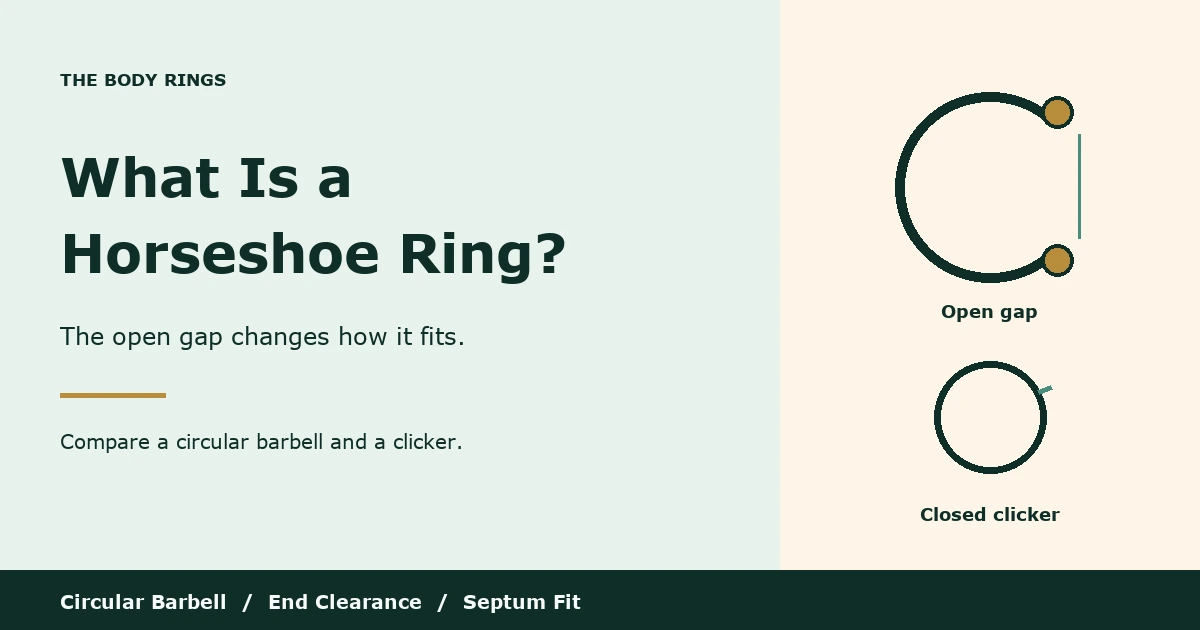
A horseshoe ring is a circular barbell with an open gap and two removable ends. For septum jewelry you want to tuck out of sight, a plain horseshoe is usually a better candidate than a closed clicker. The gap, end size, piercing position, and room inside your nose all matter. Ask a piercer to assess fit, and avoid rotating jewelry during healing.
Key Takeaways
- A horseshoe ring has an open gap between two ends. A clicker closes into a complete loop, and a traditional captive bead ring holds one bead between the tips.
- Gauge tells you the thickness of the part worn through the piercing. Inside diameter, end size, and the gap tell you different things about how a horseshoe sits.
- For a septum piercing, shop by the look you want first: two separate ends, a continuous hoop, or a discreet piece fitted for concealment.
- If a ring presses, catches, or resists movement, stop and get the fit checked. A fresh or irritated piercing needs professional guidance before you change jewelry.
- Compare shapes in the septum jewelry collection, then check the individual product’s dimensions before ordering.
What makes a horseshoe ring different?
A horseshoe ring is the common name for a circular barbell that curves around most of a circle. It ends in two separate caps, often balls or cones. Look at the space between the caps: it stays open when the jewelry is assembled. On a threaded model, at least one end unscrews. Confirm how the model is built before ordering replacement ends or trying to open an unfamiliar piece.
A clicker has a hinged section that swings open and latches into the opposite side. Once closed, it makes a continuous loop. A traditional captive bead ring uses tension from the ring to hold a single bead between its tips. A curved barbell also has two ends, but its shaft takes a shorter arc. When a listing uses the word “ring” for several designs, the product photo and closure description are more useful than the name alone.
| Option | Best for | Caveat |
|---|---|---|
| Plain horseshoe with round ends | A visible two-end shape or a septum fit check for discreet wear | Oversized ends or a narrow gap can block clearance even when the diameter looks right. |
| Decorative horseshoe with cones or gems | A more prominent two-end look on a compatible healed piercing | A decorative end can take up extra room or catch on fabric. |
| Hinged clicker | A continuous ring with a hinged closure | A closed profile and any forward-facing decoration make it a poor default for tucking up. |
| Captive bead ring | A continuous ring with one bead as the focal point | Its bead relies on tension. The opening method differs from a threaded circular barbell. |
| Septum retainer | Discreet wear when a piercer confirms the shape and fit | Retainers vary. Check the profile, gauge, and suitability for your piercing before switching. |
Can a horseshoe or clicker be tucked out of sight?
If concealment matters, start by asking a piercer about a plain horseshoe or a septum retainer. The open gap on a horseshoe can give the ends room to pass around the tissue between the nostrils. That clearance depends on the piece and the person. Two rings with the same advertised inside diameter can behave differently if one has wide decorative ends and the other has small balls.
A clicker may rotate within a healed channel, but rotation and concealment are different. A closed loop can still be visible even after its hinge has moved. A gem cluster or deep front arc can project farther than the small hinge suggests. Buy a clicker for the way its front looks when worn down. If the ring must disappear for work, a fitted retainer or horseshoe is the more practical shape to discuss before buying.
Evaluate the requirement in the position you need most often. A person who wants a visible ring on weekends and a discreet look during every work shift needs a piece suited to both positions. A person who needs the piercing to stay discreet most days may prefer to keep a retainer in place. Ask your piercer about the plan before a new piercing, especially when workplace rules would otherwise require frequent movement or removal.
How do you read the size on a horseshoe ring?
Gauge refers to the thickness of the wearable shaft. A 16G shaft is approximately 1.2 mm thick, and a 14G shaft is approximately 1.6 mm thick. A lower gauge number means a thicker shaft. Treat these as examples of label conventions. Confirm the gauge of the jewelry that fits you now before ordering. Selecting a larger curve keeps the same shaft thickness only when the gauge stays the same.
Inside diameter measures the ring across the inside of the curve. Use it to compare the room within similar round designs and the likely amount of drop when worn down. If you know your current size, the 8 mm vs 10 mm septum ring guide illustrates how the two labels relate to fit. A nominal diameter tells you little about the gap between the ends.
End size and gap describe the assembled jewelry. Two 16G horseshoes with an 8 mm inside diameter can have different ball diameters, different end spacing, or different contours. A larger ball may make the ends easier to see, while a smaller ball may leave more clearance. If the gap matters and the seller only lists gauge and diameter, ask for the distance between the closest points on the installed ends. A front photo gives you the shape. A measurement gives you something you can compare.
Overall height and width help with tall cones or decorative caps. If a ring looks similar to one you already own, compare how far its ends extend beyond the curve. A tall cone changes the outline even when the shaft and inside diameter match. For a ring sold with more than one size option, make sure the selected variant matches the listing photo or dimension chart you are reading.
Which style fits the way you plan to wear it?
For a visible septum look, compare the two-end silhouette against a continuous loop. A plain ball-end design keeps the gap readable from the front. A more decorative clicker puts its visual weight along the center of the ring. Side photos can reveal whether a front panel stands out from the curve, something a straight-on shot often hides.
For a snug look, start with the dimensions of a comfortable piece and check whether the new one changes its shape. A close-fitting arc can still have bulky ends. A visually compact ring that digs into the underside of the nose needs a different fit assessment, even when the dimensions match a generic size chart. A shop photo cannot show where your channel sits or how much clearance your anatomy leaves.
For an ear or lip piercing, assess the placement separately before reusing a septum size. The curve may sit beside a different amount of tissue, and the cap may come close to a fold, touch a tooth, or catch under headphones. If you want the same visual style in multiple placements, each piece still needs its own gauge, diameter, and end-size decision. If you are comparing rings in the lip jewelry collection, ask a piercer about contact with teeth or gums before choosing a style.
What should you check before ordering?
- Confirm the placement and current gauge. Use your piercer’s sizing record or ask them to assess the piece you already wear. Retail shorthand like “nose ring” can refer to several shapes and locations.
- Compare the inside diameter with a piece you know. For a change in appearance, identify what you want to change: the amount of visible drop, the gap, the cap shape, or the apparent thickness. Each feature has its own dimension.
- Check the closure and replacement ends. An internally threaded end has a post that screws into the shaft. An externally threaded shaft has threads at its tip. Even two parts sold at the same gauge may use different threading, so confirm the specific fit before mixing components.
- Check the product description for both dimensions and finish. Color names and photographs show appearance. The listing should identify the underlying material if that information is important to your decision. For a sensitivity concern, discuss exact product information with a piercer or clinician.
- Inspect loose jewelry outside the body first. Identify which end moves and how it seats, and look for damage, roughness, or a cap that will not stay seated. If the installed piece presses or resists movement, a piercer can assess the fit without forcing it.
Safety and When to Ask a Piercer
The Association of Professional Piercers’ aftercare guidance advises against twisting, spinning, or rotating jewelry while a piercing heals, and recommends a qualified piercer for jewelry changes during healing. Discuss discreet wear in advance if you are planning a new septum piercing. If the piece already in place pinches, catches, or will only move with force, stop and get the fit checked.
For a fresh, painful, swollen, irritated, migrating, or anatomy-specific piercing, have a qualified piercer assess the jewelry and placement. If you suspect infection, seek care from a qualified clinician. This is jewelry education, not medical advice.
FAQ
Can I flip up a clicker septum ring or only a horseshoe?
A plain horseshoe is usually the better candidate because the open gap can leave clearance for the two ends. A clicker closes into a loop, so turning it often leaves part of the ring visible. Fit depends on placement, gap, and end size. Ask a piercer to check before trying it while healing.
What is the difference between a horseshoe ring and a circular barbell?
In body jewelry listings, horseshoe ring usually refers to an open circular barbell with two fitted ends. The names can describe the same piece. Check that the photo shows the gap and the product details identify the closure, because stores sometimes use ring terminology for several different shapes.
Do all 16G horseshoe rings fit the same way?
No. The 16G label describes the thickness of the shaft that passes through the piercing. The curve may be wider or narrower, and the ends may be larger or spaced farther apart. Compare gauge, inside diameter, and end size separately, especially if you need room to tuck the jewelry up.
Is a horseshoe ring the same as a captive bead ring?
A traditional captive bead ring holds one bead under tension between the ring tips. A circular barbell has two separate ends with an open gap between them. A cap from a threaded horseshoe and a captive bead use different attachment mechanisms. Check which closure your piece has before buying parts.
Why can I see my horseshoe ends when the ring is tucked up?
The caps may project past the nostril opening, or the piece may have too little clearance at the gap. Piercing placement also affects where the ends rest. Ask a piercer to check the gap, end profile, and diameter together. Avoid pressing the ends inward or bending the jewelry yourself.
Can I buy a horseshoe ring using only the diameter on my clicker?
Use that diameter as a starting point for the amount of visible drop. Verify the gauge separately, then check how far the caps extend and how wide the gap is when assembled. A clicker and a horseshoe can share a nominal diameter while taking up different space inside and outside the nostrils.
Where to compare horseshoe rings
Browse the septum jewelry collection to compare open and hinged designs. See the 16G ball-end horseshoe for a plain two-end profile. If tuck-up clearance is the priority, establish your gauge, the gap you need, and the end size with a professional piercer before ordering.
Editorial note
Editorial note: This guide is for jewelry education and shopping support, not medical advice. For fresh, painful, swollen, infected, irritated, migrating, or anatomy-specific piercings, consult a professional piercer or qualified clinician. Reviewed for sizing language, material safety wording, care boundaries, and product-selection clarity.
