

Quick Answer
Most daith piercings are worn at 16G (1.2 mm) with a ring that has an 8 mm inside diameter. Choose 10 mm when the daith fold is larger or you want extra room around the ring, and 6 mm only for a small, tight fold on a fully settled piercing. Anatomy varies, so confirm gauge and diameter with your piercer before ordering.
Key Takeaways
- A daith ring is defined by two numbers: gauge (wire thickness) and inside diameter (open space across the ring).
- 16G (1.2 mm) is the most common daith gauge; 18G (1.0 mm) jewelry fits only a piercing actually worn at that size.
- 8 mm inside diameter fits most daith folds, 10 mm adds room for larger anatomy, and 6 mm fits only small folds.
- Fresh, swollen, painful, or irritated daith piercings should not be resized or changed without a professional piercer or qualified clinician.
- For shopping, start with daith jewelry and compare the listed gauge and inside diameter before choosing a design.
What size is a daith ring?
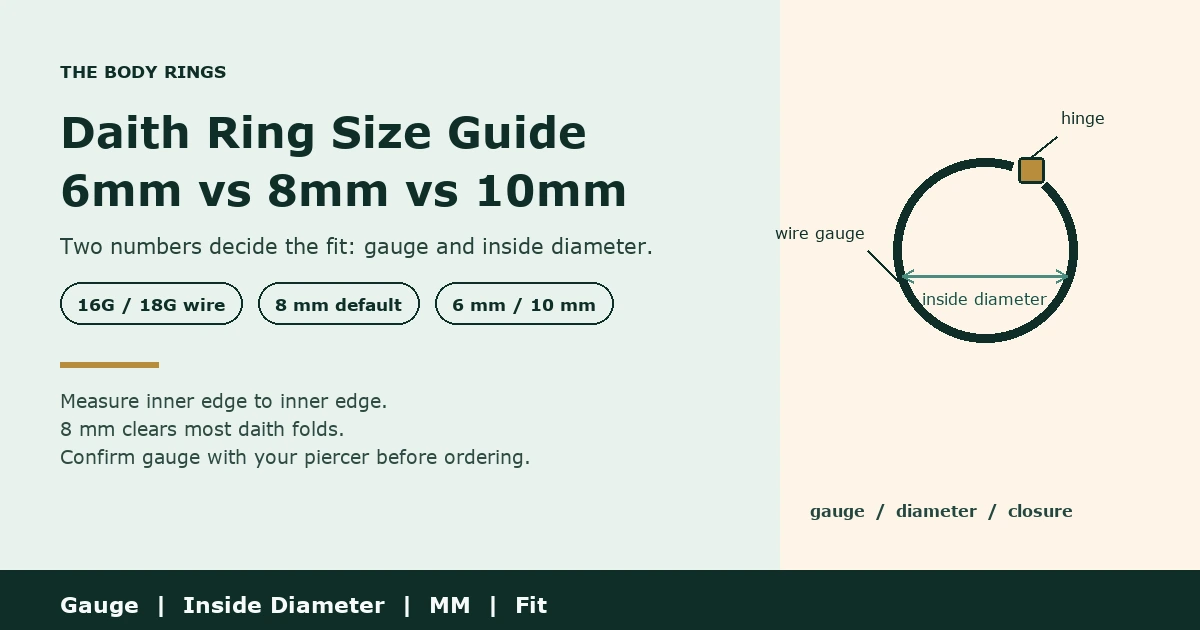
A daith ring is sized by two numbers, not one. Gauge describes the thickness of the wire that passes through the piercing. Inside diameter describes the open space across the ring, measured from one inner edge to the other. A ring can be the correct gauge and still be the wrong diameter, so both numbers have to match the piercing you have.
For most healed daith piercings, that combination is 16G (1.2 mm) wire with an 8 mm inside diameter. A larger fold usually reads better in 10 mm, and a small fold can settle into 6 mm. If the piercing is not settled yet, ring size is a piercer decision rather than a shopping decision, because swelling room changes what fits.
What gauge is a daith piercing?
Most daith piercings are worn at 16G (1.2 mm). Some jewelry is sold at 18G (1.0 mm), and a smaller share of daith piercings are worn at that thickness. The correct gauge is the one the piercing is already wearing, not the one that seems more popular. Thicker jewelry than the piercing is used to is a stretch, and thinner jewelry can sit loose and shift.
If you do not know your gauge, measure the wire of a ring you already wear comfortably with a caliper or a fine ruler, or ask the piercer who did the work. The numbers below are reference values for reading listings.
| Gauge | Millimeters | Inches | Common use |
|---|---|---|---|
| 18G | 1.0 mm | 0.039 in | Smaller cartilage and nostril jewelry; some daith rings |
| 16G | 1.2 mm | 0.048 in | The most common daith, septum and cartilage ring gauge |
| 14G | 1.6 mm | 0.063 in | Heavier rings, only where the piercing is already worn at 14G |
| 12G | 2.0 mm | 0.079 in | Stretched placements; not a starting size for a daith |
6mm vs 8mm vs 10mm: which inside diameter fits?
Inside diameter decides how the ring sits against the ear. Too small and the ring presses on the fold; too large and it swings, catches, and looks oversized. The table compares the three sizes shoppers actually choose.
| Option | Best for | Caveat |
|---|---|---|
| 6 mm (1/4 in) | Small, tight daith folds on a fully settled piercing | Too tight on average anatomy; can pinch a fuller fold |
| 8 mm (5/16 in) | Most daith folds; the default starting point | Still confirm before ordering; anatomy varies |
| 10 mm (3/8 in) | Larger folds, extra room, layered looks | Sits looser; can swing or catch on headphones and masks |
| 12 mm (1/2 in) | Statement and dangle styles | Much looser; usually a styling choice rather than a fitted one |
6 mm (1/4 in). This size only works when the daith fold is small and the piercing is fully settled. On an average fold it presses against the cartilage ridge. Shoppers often pick 6 mm because a photo looks neat; the photo does not show the fold.
8 mm (5/16 in). The default answer to “how many mm should a daith ring be” for most people. It clears a standard fold without leaving a visible gap, and most daith clickers and hoops are designed around it. If you are buying a first ring, start the sizing conversation here.
10 mm (3/8 in). Suits a larger fold, adds room around a settling piercing, or creates a looser layered look. The tradeoff is movement: a larger ring swings more and catches on headphones, hoods, and hair ties more often.
12 mm (1/2 in) and above. A styling choice for dangle or statement pieces, rarely a fit answer.
How to measure your daith for a ring
The reliable source of a daith measurement is the piercer who did the piercing. Ask for two numbers in writing: the gauge you are wearing and the inside diameter that fits your fold. The steps below are a fallback for when that record is not available.
- Measure jewelry, not skin. Measure the inside diameter of a ring you already wear comfortably in the daith, from inner edge to inner edge, with a caliper or a ruler marked in millimeters.
- Measure the wire thickness too. A caliper reads 1.2 mm and 1.0 mm apart more clearly than a ruler.
- Convert once, not twice. Work in millimeters and use the listing’s millimeter number; converting inches back and forth is where ordering errors start.
- Compare before you order. If the listing does not print gauge and inside diameter, ask the seller for the exact measurement instead of guessing from photos.
Our body jewelry conversion chart covers inches to millimeters, and our guide to measuring body jewelry at home explains the ruler method in detail.
Clickers, hoops and seams: which styles fit a daith
A daith ring is a closure question as much as a size question. Each closure changes how the ring opens, how it sits, and what can go wrong with retention.
- Clicker. A hinged segment clicks shut with no bead to lose. The Scalloped CZ and Pear Cluster CZ clicker hoops in our store use this closure.
- Captive bead ring. A bead is held by ring tension; the opening and closing method matters, and forcing it damages the ring. Our captive bead ring how-to covers the open-and-close steps.
- Seam ring. A continuous ring twisted open and closed at the seam; the seam should not sit in the channel.
- Segment ring. A hinged or removable segment with a smooth continuous look when closed.
Whatever the closure, confirm gauge and inside diameter first, then judge the design. For a wider look at closures, see our body jewelry ring types guide.
Sizing mistakes to avoid
- Buying from a photo. A ring photographed on a model or a flat lay carries no measurement. Read the numbers on the listing.
- Assuming the gauge. “Small” in a product title is a style word. If the listing does not print gauge, ask before ordering.
- Changing jewelry too early. A settling piercing has different room needs than a healed one; first-change timing belongs to a professional piercer.
- Ignoring material wording. 316L stainless steel is a steel alloy and contains nickel; titanium and silver read differently in a listing. Read the material wording exactly as written and check our material certifications page if a placement is sensitive.
- Ordering a size to “stretch into.” A ring is not a taper. Forcing a larger gauge through a settled piercing is a modification decision for a piercer, not a shopping trick.
Safety and when to ask a piercer
If your daith is fresh, painful, swollen, infected, irritated, migrating, or anatomy-specific, sizing and jewelry changes need a professional piercer or qualified clinician, not a shopping guide. Fit pressure can read as soreness, and a ring that is too small on a settling piercing is a common source of irritation. The Body Rings content is jewelry education and shopping support, not medical advice. The Association of Professional Piercers aftercare guidance is a useful independent reference for care questions.
What to buy: daith jewelry paths
Start with the daith jewelry collection to compare clickers and hoops in one place, then check the two numbers on each listing:
- Browse the Daith Jewelry, Clickers & Hoops collection for hinged clickers and rings sized for the placement.
- The Scalloped CZ Clicker Hoop — Stainless Steel is a hinged clicker listed as 316L stainless steel with supplier-listed CZ stones; it clicks shut with no bead to lose.
- The Pear Cluster CZ Clicker Hoop — Rose Gold uses the same clicker closure in a rose gold tone finish.
These listings describe material and closure but do not publish gauge and inside diameter on the page, so measure what you already wear and confirm the exact measurement before ordering. For the wider ear catalog, browse Ear Jewelry & Cartilage Studs.
FAQ
How many mm should a daith ring be?
Most daith piercings wear an 8 mm inside diameter ring, which clears a standard daith fold without a visible gap. Choose 10 mm for a larger fold or extra room, and 6 mm only for a small, settled fold. Anatomy varies, so confirm the measurement with your piercer before ordering.
Is an 8mm or 10mm ring better for a daith piercing?
8 mm is the better default for most daith folds; 10 mm is the better choice when the fold is larger, the piercing is still settling, or you want a looser layered look. A 10 mm ring moves more and catches on headphones more easily, so the right answer depends on anatomy and how the ring is worn.
What gauge is a daith piercing?
Most daith piercings are worn at 16G (1.2 mm), and some are worn at 18G (1.0 mm). The correct gauge is whatever the piercing currently wears. Thicker jewelry is a stretch, and thinner jewelry can sit loose and shift. If you are unsure, measure the wire of a ring you wear comfortably or ask your piercer.
How do I measure my daith for a ring?
Measure a ring you already wear comfortably in the daith: use a caliper or fine ruler to read the inside diameter from inner edge to inner edge, and the wire thickness for gauge. Measuring the ear itself is unreliable. If no comfortable jewelry exists, ask the piercer for gauge and inside diameter before ordering.
Can I wear a daith ring during an MRI?
MRI facilities set their own rules about metal jewelry, and many ask for removal before a scan. Ask the facility in advance. If the piercing is not settled, do not remove or swap jewelry on your own; a retainer change needs professional piercer guidance.
Can I change my daith ring myself?
On a fully settled piercing, many people change jewelry themselves with clean hands and a mirror, using the closure method the ring is built for. On a fresh, irritated, or swollen piercing, leave jewelry changes to a professional piercer. Forcing a closure or the wrong gauge can damage the ring and the piercing.
What jewelry styles can I wear in a daith?
Clickers, captive bead rings, seam rings, and segment rings all fit a daith when the gauge and inside diameter match the piercing. Closures decide how the ring opens and how securely it sits; design decides the look. Confirm measurements first, then pick the closure and style you prefer.
Editorial note
Editorial note: This guide is for jewelry education and shopping support, not medical advice. For fresh, painful, swollen, infected, irritated, migrating, or anatomy-specific piercings, consult a professional piercer or qualified clinician. Reviewed for sizing language, material safety wording, care boundaries, and product-selection clarity.