

Quick Answer
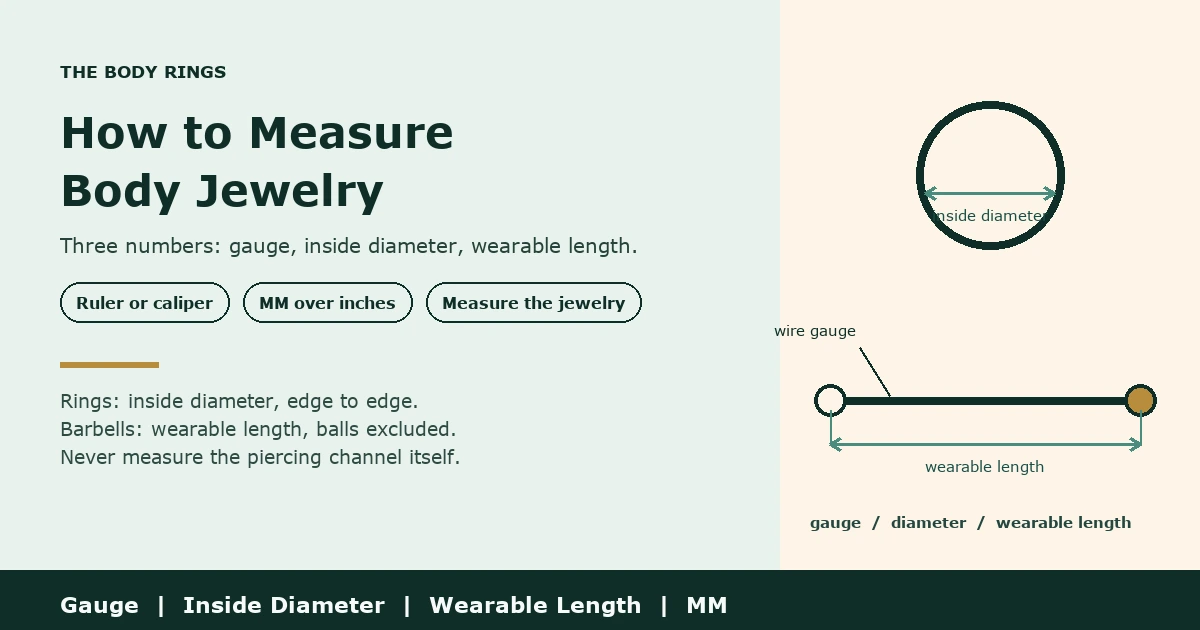
Measure the jewelry, not the piercing. Body jewelry is defined by three numbers: gauge (wire thickness), inside diameter (rings), and wearable length (barbells and studs), all in millimeters. If the piercing is fresh, swollen, or irritated, do not press tools into the channel; sizing changes at that stage belong to a professional piercer.
Key Takeaways
- Measure jewelry, never the piercing channel: the three numbers are gauge, inside diameter, and wearable length.
- Gauge numbers run backwards: 14G (1.6 mm) is thicker than 18G (1.0 mm), so read listings in millimeters.
- Inside diameter fits rings; wearable length fits barbells and studs; neither is the total length.
- Do not measure or resize a fresh, painful, swollen, or irritated piercing yourself; a professional piercer owns that decision.
- For shopping, browse belly rings or nose studs and compare printed numbers, never photos.
What the three measurements actually are
Gauge is wire thickness — how thick the metal is where it passes through the piercing. The gauge system runs backwards: a smaller number means thicker wire, so 14G (1.6 mm) is thicker than 16G (1.2 mm). Gauge is fit-critical. Thicker jewelry than the piercing wears is a stretch; thinner jewelry can sit loose and shift.
Inside diameter is the open space across a ring. It decides how a hoop, clicker, captive ring, or horseshoe sits against the body. A ring can be the correct gauge and the wrong diameter at once.
Wearable length is the part inside the piercing. On barbells and labret studs it is the shaft length between the end pieces, measured without balls, gems, or decorative tops. It is not the total length, and confusing the two is the most common measuring mistake.
Tools: ruler, caliper, and what not to measure
A millimeter ruler handles inside diameter and wearable length well enough for shopping. A digital caliper adds accurate wire-thickness readings, because the difference between 1.0 mm and 1.2 mm is nearly invisible to a ruler but matters to the piercing.
Three rules apply to every tool. Measure in millimeters and convert once; converting inches back and forth is where ordering errors start. Measure on a flat, well-lit surface. Never insert a caliper or any tool into a piercing channel. Phone measuring apps are unreliable because camera scale drifts.
How to measure rings: hoops, clickers and horseshoes
For any ring style, the number that matters is the inside diameter. Lay the ring flat and measure straight across the open space from inner edge to inner edge, at the widest point, without the wire or any beads and threaded balls. Circular barbells and horseshoes follow the same rule. If the measurement lands between two standard sizes, compare in millimeters — a 1 mm difference decides whether a ring pinches or swings.
| Fractional size | Millimeters | Common use |
|---|---|---|
| 1/4 in | 6 mm | Very small cartilage rings; small daith folds |
| 5/16 in | 8 mm | Standard septum and daith rings; small nostril hoops |
| 3/8 in | 10 mm | Larger cartilage folds; looser septum and nostril fits |
| 1/2 in | 12 mm | Statement rings; loose layered looks |
| 5/8 in | 16 mm | Large hoops; stretched placements |
Note that 3/8 in is technically 9.5 mm, but listings round it to 10 mm. When in doubt, trust the printed millimeters.
How to measure barbells and studs
Straight barbells. Remove the balls if they unscrew and measure the shaft end to end — that is the wearable length. If the balls are fixed, measure inside edge to inside edge of the end pieces.
Curved barbells. Measure in a straight line between the two ends, not along the curve; the arc is how jewelry arrives too long.
Labret studs and flat backs. Measure the post only, from the backing plate to the top end of the shaft, excluding thread, pins, and decorative tops. Common wearable lengths run about 6 mm to 10 mm (1/4 in to 3/8 in); swelling room on fresh piercings is a piercer decision.
Nose studs. Measure the wearable portion of the post. Nose screw and L-shape posts are short by design, usually 5 mm to 7 mm, and do not interchange with cartilage studs even when the gauge matches.
| Jewelry type | What to measure | How | Common mistake |
|---|---|---|---|
| Hoops, clickers, captives | Inside diameter | Across the opening, inner edge to inner edge | Including the wire or beads |
| Straight barbell | Wearable length | Shaft end to end, balls excluded | Measuring total length |
| Curved barbell | Wearable length | Straight line between the two ends | Measuring along the arc |
| Horseshoe / circular barbell | Inside diameter | Across the opening, balls excluded | Measuring outside diameter |
| Labret stud | Post length | Backing plate to end of the shaft | Counting thread or the top |
| Nose stud | Wearable post | The portion inside the nostril | Matching cartilage lengths |
Gauge to millimeters: the reference table
Gauge is the number most listings print first and the one shoppers misread most often. Our piercing gauge chart covers every size by jewelry type, and the inches-to-millimeters conversion chart handles fractional conversions.
| Gauge | Millimeters | Inches | Common use |
|---|---|---|---|
| 20G | 0.8 mm | 0.032 in | Nostril studs; standard earring posts |
| 18G | 1.0 mm | 0.039 in | Nostril jewelry; smaller cartilage pieces |
| 16G | 1.2 mm | 0.048 in | Most cartilage, septum, daith and labret jewelry |
| 14G | 1.6 mm | 0.063 in | Belly rings, nipple bars, tongue and industrial bars |
| 12G | 2.0 mm | 0.079 in | Heavier rings; stretched placements |
Measuring mistakes that cost orders
Measuring from a photo. A ring on a model or a flat lay carries no measurement. Read the printed numbers on the listing, and ask the seller if none are printed.
Confusing total length with wearable length. Balls, gems, and decorative tops do not sit inside the piercing; only the shaft does. A barbell measured including balls arrives shorter than expected.
Trusting an old gauge. Piercings shrink and settle over time. The gauge you were pierced at is history; measure a piece that fits comfortably right now.
Measuring the piercing instead of the jewelry. Skin compresses and channels curve. A piece of jewelry that already fits is the most accurate sizing reference you own.
Ordering a size to stretch into. Jewelry is not a taper. Forcing thicker wire through a settled piercing is a modification decision for a piercer, not a shopping shortcut.
Safety and when to ask a piercer
Measuring jewelry is safe homework. Measuring, resizing, or swapping jewelry on a fresh, painful, swollen, infected, irritated, or migrating piercing is not. At that stage the channel itself is changing, and sizing decisions belong to a professional piercer or qualified clinician. Never press a caliper into a fresh channel, and never remove jewelry just to measure it if the piercing is not settled. The Body Rings content is jewelry education and shopping support, not medical advice. The Association of Professional Piercers publishes independent aftercare guidance.
What to buy: putting measurements to work
Measure first, shop second. Once you know your three numbers, compare them against what each listing prints:
- Browse belly rings for 14G curved barbells, and check the printed bar length against your wearable measurement; our belly ring sizes guide explains the numbers.
- The Ball Horseshoe Circular Barbell — 16G, Titanium prints its gauge in the title; match the 16G wire to your measurement, then confirm the inside diameter before ordering.
- The Scalloped CZ Clicker Hoop — Stainless Steel is a hinged ring in 316L stainless steel; the inside diameter decides the fit, so measure a ring that already sits well first.
- For ear and cartilage pieces, browse ear jewelry and compare post lengths against your measurements; the nose stud size chart covers nostril-specific numbers.
Where a listing does not print measurements, ask before ordering rather than guessing from photos. If a placement is sensitive, check the material wording exactly as written and review our material certifications page.
FAQ
How can I tell what size my piercing is?
Measure a piece of jewelry that already fits comfortably, not the piercing itself. Read the wire thickness for gauge and the inside diameter or wearable length for fit, with a millimeter ruler or caliper. If nothing you own fits well, ask the piercer for the numbers in writing.
Is 9/16 bigger than 5/8 in piercings?
No. 5/8 inch (16 mm) is larger than 9/16 inch (14 mm). Written with the same denominator, 5/8 equals 10/16, which is larger than 9/16. Comparing in millimeters removes the confusion.
How big is 10 mm in jewelry?
10 mm is about 3/8 inch. As an inside diameter it suits larger cartilage folds and looser septum or nostril fits; as a wearable length it is a longer post or bar. Check which one the listing prints, because the number fits differently as a diameter or a length.
How do I know if my piercing is 14G or 16G?
Measure the wire thickness of jewelry that fits comfortably with a caliper: 1.2 mm is 16G and 1.6 mm is 14G. The difference is only 0.4 mm, so a ruler often cannot separate them. If you cannot measure, ask the piercer rather than forcing jewelry to test it.
What is the 3/2 piercing rule?
It is an informal jewelry-proportion heuristic shared in piercing communities, not a measurement standard or safety rule, and it does not replace measuring. Sizing should come from the three real numbers — gauge, inside diameter, wearable length — confirmed in millimeters against jewelry that fits.
What gauge is a standard earring?
Standard earring posts are usually 20G (0.8 mm). Cartilage and body piercings run thicker: 16G (1.2 mm) for most cartilage, septum, and labret jewelry, and 14G (1.6 mm) for belly, nipple, and industrial pieces. Match the gauge the piercing currently wears, not the one a listing calls standard.
Editorial note
Editorial note: This guide is for jewelry education and shopping support, not medical advice. For fresh, painful, swollen, infected, irritated, migrating, or anatomy-specific piercings, consult a professional piercer or qualified clinician. Reviewed for sizing language, material safety wording, care boundaries, and product-selection clarity.