

Quick Answer
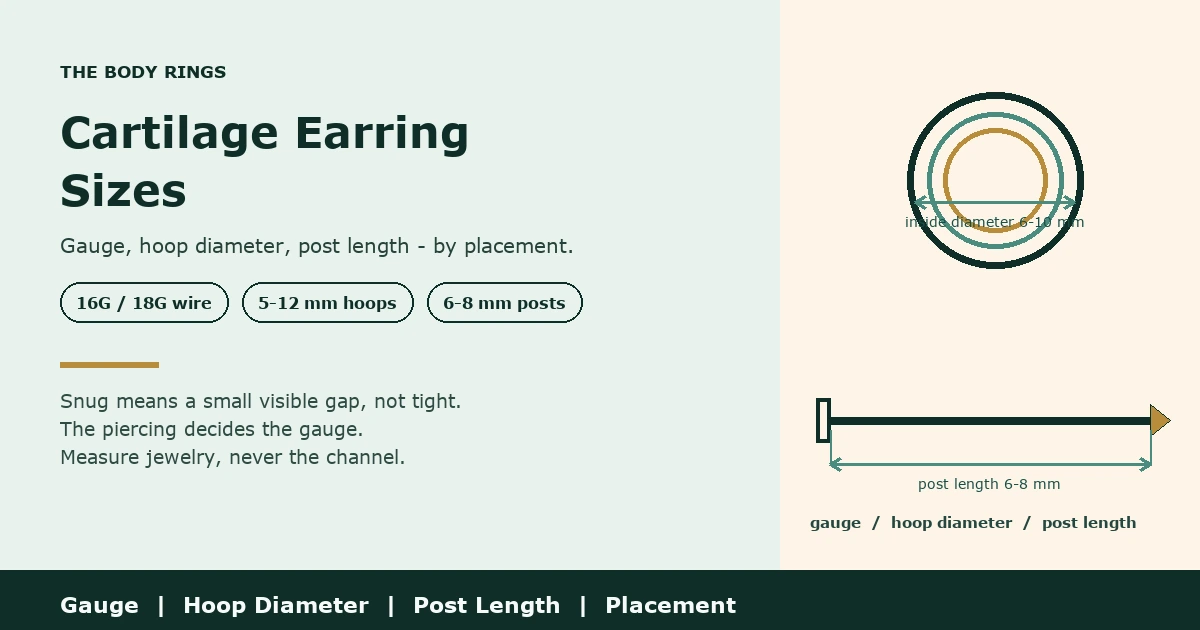
Cartilage jewelry is sized in three numbers: wire gauge (most cartilage piercings wear 16G/1.2 mm, some 18G/1.0 mm), inside diameter for hoops (5 mm to 12 mm depending on placement), and post length for studs (usually 6 mm to 8 mm healed). If the piercing is fresh or swollen, post length is longer on purpose — changing it is a professional piercer’s decision, not a shopping decision.
Key Takeaways
- Cartilage sizing is three numbers, not one: gauge (wire thickness), inside diameter (hoops), and post length (studs).
- Most cartilage piercings are done at 16G or 18G; the piercing decides the gauge, and thinner wire than the piercing can slide into the channel.
- Snug means a small visible gap between hoop and skin — if the hoop edge touches skin all around, it is too tight.
- Fresh, painful, swollen, or irritated cartilage piercings should never be resized or restyled without a professional piercer.
- For shopping, browse ear piercing jewelry and match the printed millimeters to your placement before comparing styles.
What size is a cartilage piercing?
Most cartilage piercings are done at 16G (1.2 mm), and a minority at 18G (1.0 mm). That is the wire thickness the channel was made for, and it is the one number you cannot choose freely: thicker wire than the piercing is a stretch, thinner wire can migrate inside the channel because fine wire acts like a cheese cutter under pressure. Lobe piercings are usually thinner (20G/0.8 mm), which is why regular earrings do not substitute for cartilage jewelry.
When a listing prints only one gauge, assume the piercing decides. If you do not know what you were pierced at, the reliable answer comes from the piercer who did it — not from comparing jewelry by eye.
Hoop diameter by placement: 5 mm to 12 mm
Inside diameter is the open space across the ring, measured inner edge to inner edge. It decides how the hoop sits against the ear, and it depends entirely on where the piercing channel exits the tissue. Two ears with the same helix piercing can need different diameters, because anatomy decides how far the hole sits from the fold.
| Placement | Typical gauge | Typical hoop diameter | Caveat |
|---|---|---|---|
| Helix | 16G / 18G | 8-10 mm | 6 mm only if the hole sits very close to the fold |
| Forward helix | 16G / 18G | 5-6 mm | Small anatomy; hoops often impractical, studs dominate |
| Tragus | 16G | 5-6 mm | Thin tissue flap; larger diameters lever on the channel |
| Conch | 16G / 14G | 10-12 mm | Hoop must clear the ear edge, so it runs larger than helix |
| Flat | 16G | Studs standard | Flat cartilage rarely suits hoops at any diameter |
| Daith | 16G | 6-8 mm | Inner fold; covered in detail in the daith ring size guide |
These are the ranges most shoppers land in, not a prescription. Measure your own jewelry or have a piercer measure the piercing before ordering.
Post length for studs and flat backs
For labret-style cartilage studs, the number that matters is the wearable post length — the part inside the piercing, measured from the backing plate to the end of the shaft without thread, pins, or decorative tops. Healed cartilage piercings usually wear 6 mm or 8 mm posts. Fresh piercings are started longer on purpose to leave room for swelling, and that first downsize is a piercer appointment, not a mail-order guess.
A post that is too short sinks the backing into the tissue. A post that is too long catches on hair, masks, and pillows, and the constant levering keeps the piercing irritated. When a healed piercing gets caught and sore repeatedly, post length is one of the first things a piercer checks.
Snug fit vs tight fit
Snug means the hoop follows the shape of the ear with a small visible gap between the metal and the skin — you can slide a fingernail edge between hoop and tissue without force. Tight means the hoop edge touches skin somewhere along the curve, or the ring cannot rotate freely. Tight hoops are the mechanical cause behind many irritated cartilage piercings: constant pressure at the contact point plus trapped moisture. If a hoop leaves a visible indentation mark after removal, it was too tight, and the correct next size is the piercing plus 1 mm of diameter — not the next style.
How cartilage jewelry styles change the fit math
The same three numbers behave differently across constructions. Hoops and clickers are sized by inside diameter only. Labret studs and flat backs are sized by post length and gauge. Curved barbells are measured straight across the ends, not along the arc. Threadless tops rely on a pin bend for tension, so the post fit matters more than the top size. For construction-level differences, our flat back earrings fit guide and the threadless jewelry size guide cover posts, tops, and pin fits in detail.
| Size range | Best for | Caveat |
|---|---|---|
| 5-6 mm hoops | Tragus, forward helix, very snug helix | No room for swelling; healed piercings only |
| 8 mm hoops | Standard helix, snug conch, many daith fits | The most common cartilage diameter; still anatomy-dependent |
| 10-12 mm hoops | Conch, loose helix, layered looks | Dangles catch on hair and clothing more easily |
| 6 mm posts | Healed tragus, thin cartilage, snug fit | Too short for fresh or thick tissue |
| 8 mm posts | Most healed helix and conch studs | Leaves slight room; longest most healed cartilage needs |
| 18G wire | Piercings actually done at 18G; delicate looks | Too thin for a 16G channel; verify before ordering |
| 16G wire | Most cartilage piercings | Do not force into an 18G or 20G channel |
How to measure what you already own
Measure jewelry, never the piercing channel. For hoops, lay the ring flat and measure straight across the opening, inner edge to inner edge. For studs, unscrew the top and measure the shaft alone. A millimeter ruler is enough for diameter and length; wire gauge differences (1.0 mm vs 1.2 mm) are nearly invisible to a ruler and need a digital caliper or a piercer’s measurement. The full method, including curved barbells and nose studs, is in our guide to measuring body jewelry.
How to choose cartilage earrings
Start with the numbers, then the style. Confirm your gauge first, then pick the diameter or post length for your placement, and only then compare designs. The helix hoop size guide goes deeper on helix-specific diameter choices if that is your placement.
Useful next steps: browse ear piercing jewelry, compare placement-specific pieces in tragus jewelry and helix piercing jewelry, and check Material Certifications and Safety Info before choosing jewelry for a sensitive placement. Steel contains nickel; if your ears react to costume earrings, read the material listing line by line rather than relying on marketing words.
FAQ
What gauge is a cartilage piercing?
Most cartilage piercings are done at 16G (1.2 mm); some piercers use 18G (1.0 mm), especially for delicate placements. There is no universal standard, so the piercing decides. If you do not know your gauge, ask the piercer who did it or have the jewelry measured before ordering replacements.
What size hoop do I need for cartilage?
Most healed cartilage hoops fall between 6 mm and 10 mm inside diameter, depending on placement: 5-6 mm for tragus and forward helix, 8 mm for a standard helix, 10-12 mm for conch. Measure the inside diameter of a hoop that already fits, or have a piercer measure the piercing.
Is 20G too small for a cartilage piercing?
Often yes. Most cartilage piercings are 16G or 18G channels, and 20G wire is thin enough to shift inside the channel under pressure. Some piercings are genuinely done at 18G or thinner, so verify before ordering; standard lobe earrings are not cartilage jewelry.
How long should a cartilage earring post be?
Healed cartilage piercings usually wear 6 mm or 8 mm posts, measured as the wearable shaft without thread or decorative tops. Fresh piercings are started longer for swelling room, and downsizing is a piercer decision. A post that sinks into tissue is too short; one that catches constantly is too long.
Can I wear a hoop in a fresh cartilage piercing?
Hoops in fresh cartilage piercings are a piercer decision, not a shopping one. Many piercers start cartilage with studs because rings move more and rotate through the channel. If the piercing is fresh, painful, swollen, or irritated, do not change styles on your own — book a piercer visit first.
What happens if my cartilage hoop is too tight?
A too-tight hoop presses on the channel constantly, traps moisture, and keeps the piercing irritated; after removal it often leaves a visible indentation. The fix is sizing up by roughly 1 mm of inside diameter for a healed piercing. If irritation, swelling, or pain is already present, see a professional piercer before changing anything.
Editorial note
Editorial note: This guide is for jewelry education and shopping support, not medical advice. For fresh, painful, swollen, infected, irritated, migrating, or anatomy-specific piercings, consult a professional piercer or qualified clinician. Reviewed for sizing language, material safety wording, care boundaries, and product-selection clarity.